01
Assess
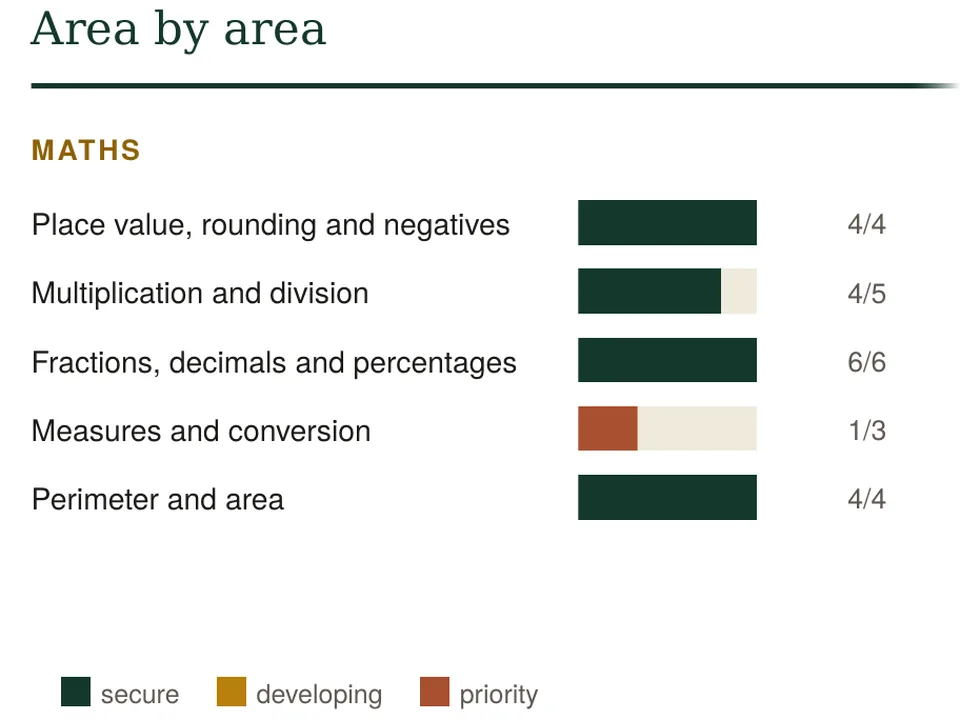
We map your child against every strand of the Key Stage 2 curriculum. Not “weak at maths”, but which objectives, in which order, are holding progress back.
11+ Tuition · Trafford & Ribble Valley
One-to-one 11+ tuition for the Trafford grammar schools and Clitheroe Royal
Including the new FSCE 11+, the Trafford test from September 2027. FSCE stands for Future Stories Community Enterprise, the not-for-profit test provider the Trafford Consortium appointed in July 2026.
The assessment is free. You get a written report showing exactly where your child stands, and you’re welcome to use it to work on things at home, whether or not you book tuition. See a sample report.
Parent reviews
Amazing tutors who helped my daughter get into grammar school, where she achieved an amazing score of 387 last year. I’ve also enrolled my second daughter, who recently sat her entrance exam and felt that it went really well for her. Thank you so much for all your help and support along the way
My daughter managed to get into her preferred grammar school with the help of this company. Thanks for your guidance! I recommend.
Makes my son feel comfortable. Great learning experience. Knows my son, makes great connection. Challenges him. He’s really grown with the tutoring
11+ Preparation · Trafford & Ribble Valley
The Trafford 11+ has changed. Reasoning is gone, and the new exam tests the Key Stage 2 curriculum. That rewards knowing exactly what your child has secured, not how many papers they have sat.
We map your child against that curriculum objective by objective, then teach only what the map says is missing.
The assessment is free. You get a written report showing exactly where your child stands, and you’re welcome to use it to work on things at home, whether or not you book tuition. See a sample report.
The change
The Trafford Consortium is replacing GL Assessment with FSCE (Future Stories Community Enterprise). Verbal and non-verbal reasoning are removed entirely, and the test moves onto the Key Stage 2 English and maths curriculum.
That is a change of kind, not of difficulty. The question stops being how many papers your child has practised and becomes which curriculum objectives are actually secure.
Read what changes, in fullWhere to start
Three different routes, and they are not interchangeable. Applying across more than one means sitting more than one test.
5 schools
Five schools, one shared test, one score. Each school then applies its own qualifying mark and its own catchment rules.
What the Consortium test involvesSeparate test
Its own admissions authority, and already using FSCE. The closest working example of the test Trafford families are heading towards.
See Clitheroe RoyalNot covered here
Neither is in the Consortium. Each runs its own admissions and its own entrance test, so either one means an additional exam rather than another use of the same score.
The Consortium
One registration and one standardised score covers all five. Each school then applies its own qualifying mark and its own catchment rules, so the same score can succeed at one and fall short at another.
| School | Type | Year 7 places | Priority area |
|---|---|---|---|
| AGSB | Boys | 202 | WA13WA14WA15M33M23 |
| AGSG | Girls | check school | check school |
| Sale Grammar | Co-educational | 190 | check school |
| Stretford Grammar | Co-educational | 160 | M32M33M41M17M15M16M21 |
| Urmston Grammar | Co-educational | check school | check school |
Checked against each school’s own admissions policy on . Where a figure is not shown, the school does not publish it in a form we are willing to reproduce. Always confirm with the school for your entry year.
The one published qualifying score
Stretford Grammar School is the only Consortium school publishing a qualifying score on its own admissions pages: 334 out of 400 for 2027 entry. The 2028 figure, the first under FSCE, has not been published and may differ. Treat any other number you are quoted as hearsay until you have seen it on the school’s own page.
How we prepare
Most tuition starts with a worksheet and a guess about what is wrong. We start with a measurement, and we do not teach a topic until we know whether it needs teaching.
We map your child against every strand of the Key Stage 2 curriculum. Not “weak at maths”, but which objectives, in which order, are holding progress back.
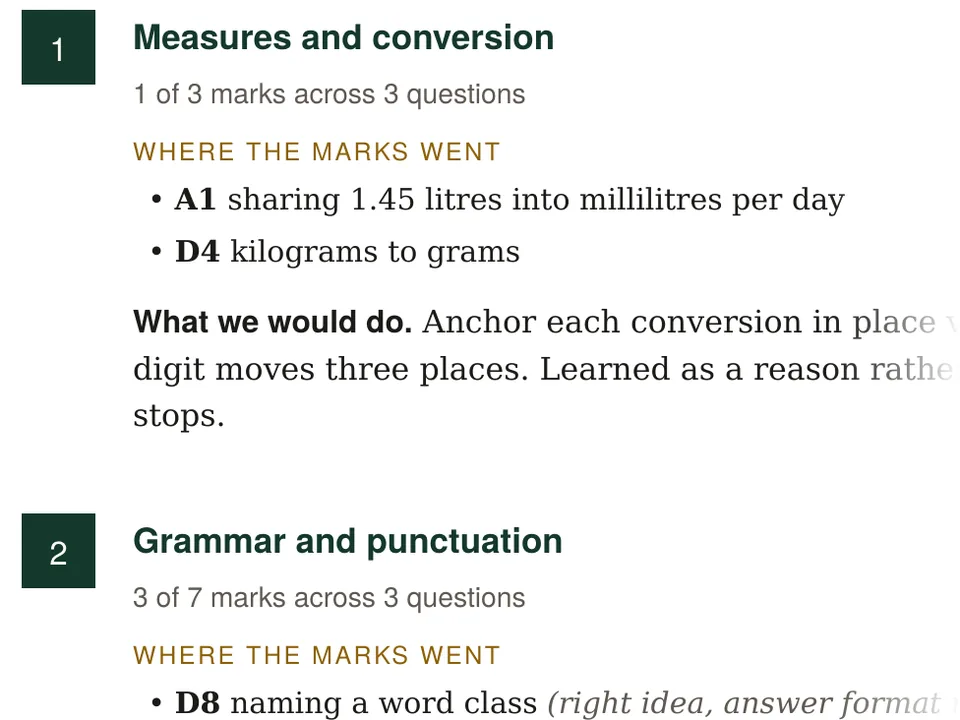
The assessment becomes a pathway: the exact sequence of skills to fix, ordered by what unlocks the most.
Sessions follow the pathway. Every session targets a gap we have measured rather than one we assumed.
We reassess as we go. The plan changes as your child does, and secure objectives drop out of it.
With the Trafford test moving onto the Key Stage 2 curriculum, this stops being a nice extra and becomes the whole job. We are a family practice, and the same small team teaches every session, so what we learn about your child in September still informs the session in March.
Key dates
The Consortium has confirmed the provider change but has not released the timetable for the first FSCE cycle. We would rather show you an empty row than a plausible guess, so this table fills in as each date is confirmed.
The one fixed point is the Common Application Form deadline, which is set nationally rather than by the Consortium.
The first cycle under FSCE.
A free diagnostic assessment maps your child against the Key Stage 2 curriculum, topic by topic, so preparation starts from evidence rather than a guess.
The assessment is free. You get a written report showing exactly where your child stands, and you’re welcome to use it to work on things at home, whether or not you book tuition. See a sample report.